
Legal PR is defined as the strategic management of public communications for law firms, lawyers, and legal matters, operating within strict ethical and confidentiality boundaries. The ICCO World PR Report 2025–2026 found that 91% of PR professionals now view AI as pivotal to the industry, and 74% already use AI tools for content creation and analytics. For legal professionals, these shifts arrive inside a practice that was already more constrained than any other communications discipline. Understanding what legal PR involves, where its boundaries sit, and how to deploy it effectively is no longer optional for law firms that want to protect their reputation and their clients.
What is legal PR and why does it matter for law firms?
Legal public relations is the specialized practice of shaping how law firms, individual attorneys, and legal proceedings are perceived by the public, the media, and key stakeholders. Unlike general PR, it operates under a layer of professional responsibility rules that govern what can be said, when, and by whom. The New York Observer named Goldman McCormick PR one of the top five legal PR agencies in 2014, recognizing the distinct expertise this discipline demands.
The importance of legal PR extends beyond winning favorable press coverage. A firm’s public reputation directly affects client acquisition, talent recruitment, and courtroom credibility. When a high-profile case breaks, the media narrative forms within hours. Firms without a prepared legal PR strategy are left reacting to coverage shaped by opposing parties, journalists, or social media speculation.

Legal PR also serves corporate clients navigating litigation. A business facing a class action lawsuit, a regulatory investigation, or a product liability claim needs coordinated messaging that protects its brand without prejudicing the legal proceedings. That coordination is the core function of legal public relations.
What ethical and legal constraints shape legal PR communications?
Model Rule 3.6 restricts lawyers from making extrajudicial statements that create a substantial likelihood of materially prejudicing a proceeding. This rule is the single most important constraint in legal PR planning, and it applies even to truthful statements. Many practitioners assume that accuracy makes a statement safe to release. It does not. A factually correct statement can still violate Rule 3.6 if it prejudices a fair trial or discloses information that influences a jury pool.
The rule does allow narrow exceptions, including statements about general procedural steps, the nature of the charges, and basic scheduling information. Some state variants, including Washington State, permit limited responsive statements when the opposing party has already made public disclosures. These exceptions require careful legal judgment, not a blanket assumption that a response is automatically permitted.
Attorney-client confidentiality under Rule 1.6 adds a second layer of constraint. PR consultants working with legal teams must understand which facts are public record, which are privileged, and which fall into a gray zone requiring attorney review before any disclosure. The key constraints in practice include:
- Extrajudicial statements: Any public comment about evidence, witness credibility, or expected outcomes is presumptively restricted under Rule 3.6.
- Client information: Disclosure of client identity, case strategy, or communications is prohibited without explicit client consent under Rule 1.6.
- Background comments: Even off-the-record briefings to journalists carry risk if they could be traced back to the attorney or influence coverage.
- Social media: Posts by attorneys or firm staff are subject to the same professional conduct rules as formal press statements.
Pro Tip: Build a written disclosure checklist before any media engagement. Categorize every potential statement as public, privileged, or requires-review. This prevents inadvertent breaches under time pressure.
How does legal PR differ from general PR?
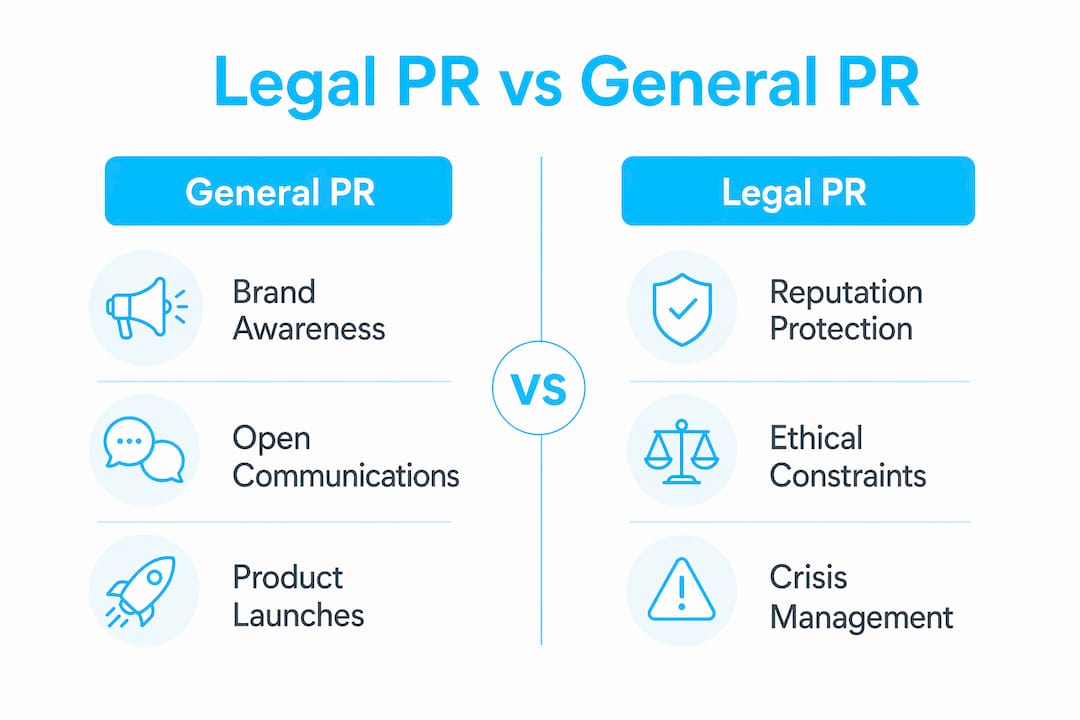
General PR focuses on brand storytelling, product launches, and reputation building in a relatively open communications environment. Legal PR operates in an adversarial context where the other side is actively working to shape a counter-narrative, and where a single misstep can harm a client’s legal position. The table below captures the core distinctions.
| Dimension | General PR | Legal PR |
|---|---|---|
| Primary goal | Brand awareness and reputation | Reputation protection within legal constraints |
| Regulatory framework | FTC guidelines, platform rules | Model Rules 3.6, 1.6, state bar regulations |
| Media strategy | Proactive storytelling | Controlled, pre-approved messaging |
| Crisis response | Speed and transparency | Measured disclosure, legal review first |
| Content approval | Marketing or executive sign-off | Attorney review required |
Legal PR includes crisis management, media training for attorneys and witnesses, and pre-approved messaging protocols designed to prevent prejudicial disclosures. Media training is particularly valuable because attorneys are not natural media performers. A well-prepared attorney who delivers a calm, controlled statement on the courthouse steps controls the narrative. An unprepared one creates the story.
Litigation PR is the most specialized subset of legal public relations. It manages public perception during active court proceedings, often running parallel to the legal defense or prosecution strategy. Firms like Goldman McCormick PR bring media relations expertise that complements legal knowledge, balancing message control with compliance requirements.
Pro Tip: Engage a legal PR firm before litigation begins, not after the first headline appears. Pre-crisis preparation costs a fraction of reactive damage control.
What trends are shaping legal PR in 2025 and 2026?
The ICCO World PR Report 2025–2026 identifies strategic consulting and corporate reputation management as the top investment priorities for PR firms globally. For legal PR, this means clients increasingly expect their PR partners to function as strategic advisors, not just media placement services. The shift reflects how digital culture evolves in real time, compressing the window between a legal development and its public impact.
| Trend | Impact on legal PR |
|---|---|
| AI content and analytics | Faster drafting, sentiment monitoring, but requires ethical oversight |
| Misinformation management | 40% cite misinformation as a top ethical challenge |
| Strategic consulting growth | Clients expect advisory roles, not just media placement |
| Measurement frameworks | ROI tracking for PR campaigns is now standard expectation |
AI tools accelerate content drafting and media monitoring, but they introduce a specific risk in legal PR. An AI-generated statement that is factually accurate but legally impermissible under Rule 3.6 creates liability. Human attorney review remains non-negotiable regardless of how the content was produced.
How to implement an effective legal PR strategy
A legal PR strategy that actually works requires coordination between legal teams and communications professionals from the start of a matter, not at the point of crisis. The following steps reflect best practice for law firms and corporate legal departments.
-
Establish a communication policy. Define who is authorized to speak to media, what categories of information are pre-approved for disclosure, and what requires attorney review. This policy should reference Model Rule 3.6 and Rule 1.6 explicitly.
-
Build a content taxonomy. Content taxonomies predefine which facts are public, which are privileged, and which are safe for background briefings. This structure speeds up approvals when media deadlines are tight and reduces the risk of inadvertent disclosure.
-
Conduct media training. Attorneys, executives, and designated spokespersons should practice on-camera and on-the-record interviews before they are needed. Preparation eliminates the hesitation that journalists interpret as evasion.
-
Engage specialized PR consultants early. Specialized PR consultants bring media relationships and message-framing expertise that internal legal teams typically lack. Early engagement allows for proactive narrative development rather than reactive damage control.
-
Measure campaign effectiveness. Track media sentiment, share of voice, and message penetration using defined metrics. Review PR campaign analytics quarterly to assess whether the strategy is achieving its reputational objectives.
-
Apply AI tools with oversight. Use AI for media monitoring and draft generation, but require attorney review of every public statement before release. Efficiency gains from AI do not reduce legal compliance obligations.
Key takeaways
Legal PR succeeds when legal compliance and communications strategy are built together from the start, not bolted together after a crisis.
| Point | Details |
|---|---|
| Core definition | Legal PR manages public perception for law firms and legal matters within strict ethical rules. |
| Rule 3.6 constraint | Even truthful statements can violate Rule 3.6 if they materially prejudice a proceeding. |
| Content taxonomy | Predefining public, privileged, and safe facts prevents inadvertent disclosure under deadline pressure. |
| AI adoption | 74% of PR professionals use AI tools, but attorney review of all legal statements remains mandatory. |
| Early engagement | Bringing in specialized legal PR consultants before litigation begins reduces crisis response costs significantly. |
The part most law firms get wrong
After working in legal communications for years, the pattern I see most often is firms treating PR as a reactive tool. A case goes public, coverage turns negative, and then someone calls a PR firm. By that point, the narrative is already set and the options are limited.
The deeper problem is the assumption that truth is a safe harbor. It is not. I have seen attorneys make accurate, well-intentioned public statements that created real exposure under Rule 3.6 because they did not account for how the statement would influence a jury pool. The rule does not ask whether you told the truth. It asks whether your statement created a substantial likelihood of prejudicing the proceeding. Those are entirely different questions.
The firms that handle legal PR well treat it the same way they treat discovery preparation. They map the terrain before they need to move fast. They know which facts are public, which are privileged, and who is authorized to speak. When a reporter calls at 6 p.m. on a Friday, they have a plan. The firms that struggle are the ones improvising in real time against a deadline and an opposing party who has already briefed the press.
AI will not fix this. AI can draft faster and monitor sentiment better than any human team. But an AI tool does not know your client’s privilege log or your jurisdiction’s variant of Rule 3.6. The technology is genuinely useful. The judgment still has to be yours.
— Ryan McCormick
How Goldman McCormick PR supports your legal communications
Goldman McCormick PR, named by Forbes Magazine as one of America’s Best PR Firms for 2021, has specialized in legal public relations services since its founding in 2010. The firm’s team brings direct media experience to every engagement, coordinating with legal counsel to develop pre-approved messaging, manage media relationships, and protect client reputations across TV, radio, and print platforms.
Goldman McCormick PR produces nationally syndicated radio programs on the Genesis Communications Network and Starcom Radio Network, giving legal clients access to broadcast audiences that traditional press releases never reach. Whether you are managing active litigation, a regulatory matter, or a firm-wide reputation initiative, Goldman McCormick PR builds the communication strategy around your legal constraints, not around them.
FAQ
What is legal PR in simple terms?
Legal PR is the practice of managing public communications for law firms and legal matters while complying with professional conduct rules like Model Rule 3.6 and attorney-client confidentiality obligations.
What does Model Rule 3.6 prohibit in legal PR?
Model Rule 3.6 prohibits lawyers from making extrajudicial statements that create a substantial likelihood of materially prejudicing a proceeding, including statements that are factually accurate.
How does legal PR differ from standard public relations?
Legal PR requires attorney review of all public statements, operates under bar association conduct rules, and prioritizes legal compliance over speed, unlike general PR where speed and transparency are typically the default approach.
Why should law firms hire a specialized legal PR firm?
Specialized legal PR firms understand both media relations and professional conduct rules, reducing the risk of inadvertent disclosure while building a proactive narrative strategy before a crisis develops.
How is AI changing legal PR practice?
74% of PR professionals already use AI for content creation and analytics, but in legal PR, every AI-generated statement still requires attorney review before public release to maintain Rule 3.6 compliance.